The PTC
4
min read
Published on
May 7, 2026
May 7, 2026



Property managers are responsible for a multitude of tasks, from leasing management to compliance and reporting, with much of the work happening behind the scenes. Estate Space has found that 70% of a property manager's time is spent on manual processes. A manager handling maintenance requests conventionally must manually execute a workflow of around 13 steps.
But what if this wasn’t the case? It’s been found that routine tasks handled by software can free up to 10-20 hours of work per week per employee. If property managers can spend less time on repetitive work, there would be more capacity for impactful communication-centric work, providing a human touch to cultivating tenant and occupant relationships.
With the hype of AI, there is a current trend in firms explicitly demonstrating their commitment to and use of cutting-edge AI innovation. However, the true value in AI and automation should be felt by end users, not necessarily seen. Automation’s value is in its potential to deliver better quality experiences while reducing administrative burden.
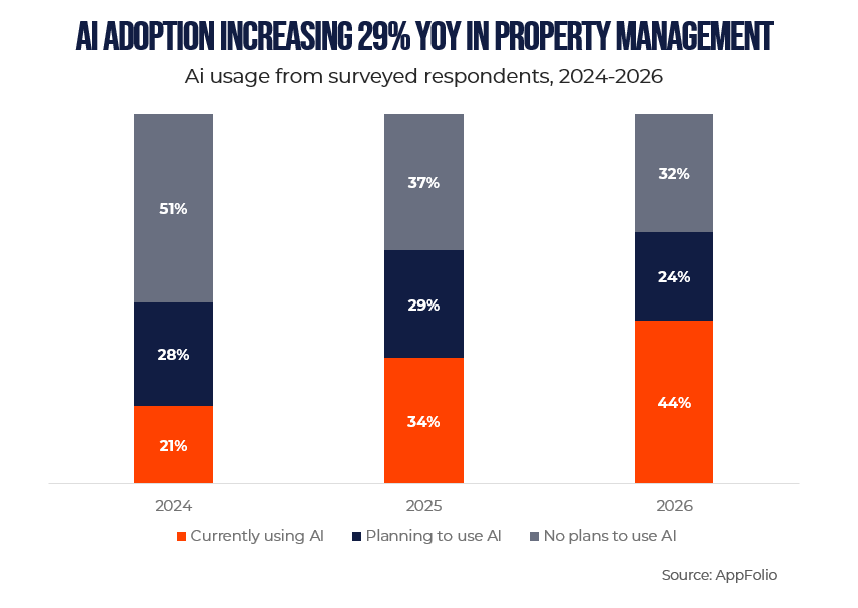
A property manager implementing AI effectively can expect faster responses, fewer errors, and proactive communication. In fact, recent research 74% of property management companies already use some form of AI for task automation, demonstrating that the business case is already commercially attractive. The issue is in the disparity of implementation, ranging from basic rule-defined automation to advanced agentic workflows. Some are experimenting with AI chatbots for communications, a tangible feature where the usage of automation is evident to the end users. While these are honourable efforts, the key value in unlocking the back office and minimising admin is often missed.
When approaching automation for property management, the key is in starting with the basic tasks that occur frequently and don’t vary much between cases. At the PTC, we segment property + building management operations into 05 core areas: leasing, maintenance, finance, communications, and compliance + reporting. Within these areas, there are multiple workflows that are prime for automation, and diving into each would require newsletters of their own; however, this newsletter will highlight some key case studies in each of these areas to demonstrate the sort of considerations made and outcomes achieved.
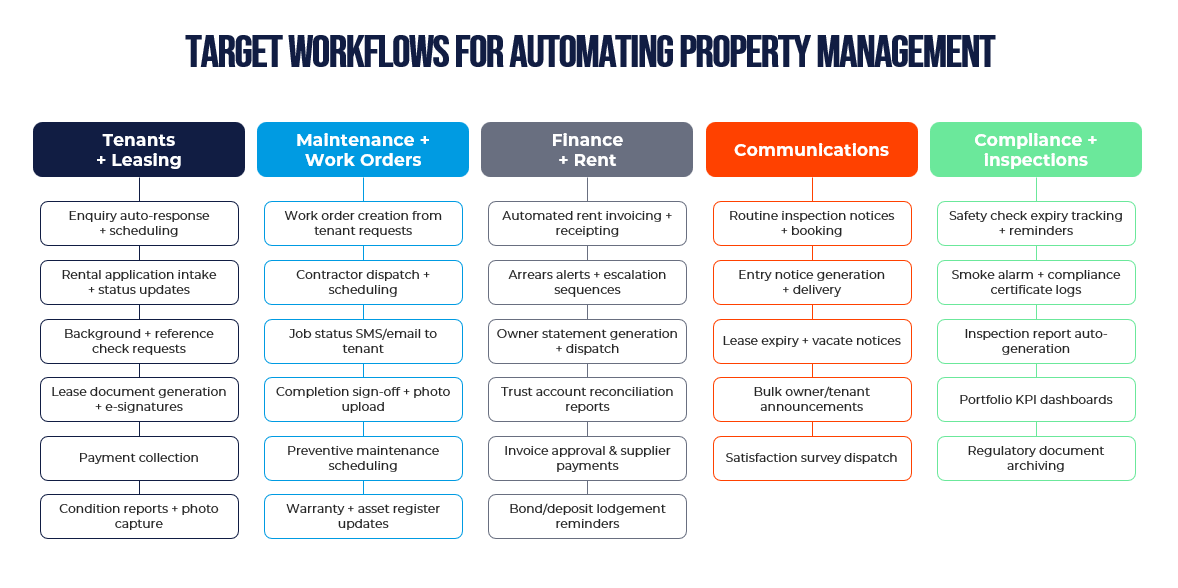
1. Tenants + Leasing
The leasing journey is one of the most process-dense activities in property management, featuring a pipeline with a clear start and end point, making it ideal for automation to improve speed and consistency.
Example: Zumper, a digital rental marketplace, has a virtual assistant that handles 70% of initial rental enquiries without human intervention
2. Maintenance + work orders
Maintenance is a high-frequency operation in property management and one most visible to tenants when it goes wrong. Automation offers the ability to reduce the coordination overhead and improve response lag.
Example: MRI Maintenance Plus integrated with other AI systems, automatically processes routine maintenance requests and has seen clients improve response times by 60%
3. Finance + rent
Rent collection, invoicing, and other finance-related workflows are often already highly rule-based in a manual context, where automation can drastically improve error rates while supporting workflows at scale.
Example: AppFolio’s Smart Bill Entry reduces overall invoice processing time by 50% by leveraging AI to automatically extract, code, and prepare invoice data for approval.
4. Communications
Property management is communication-intensive by nature, and automation can unlock higher perceived service quality at scale with less resource.
Example: Mill Creek Residential’s lead-to-tour conversion rate increased dramatically from 14% to 35% after implementing Elise AI’s conversational AI products.
5. Compliance + inspections
Compliance in property management is fundamentally a calendar and documentation problem ripe for automation, where manual tracking is a common source of legal exposure.
Example: The Dinnerstein Companies, a multi-family operator, employed HappyCo’s centralized maintenance solutions to improve after-hours call handling and provide real-time performance metrics.
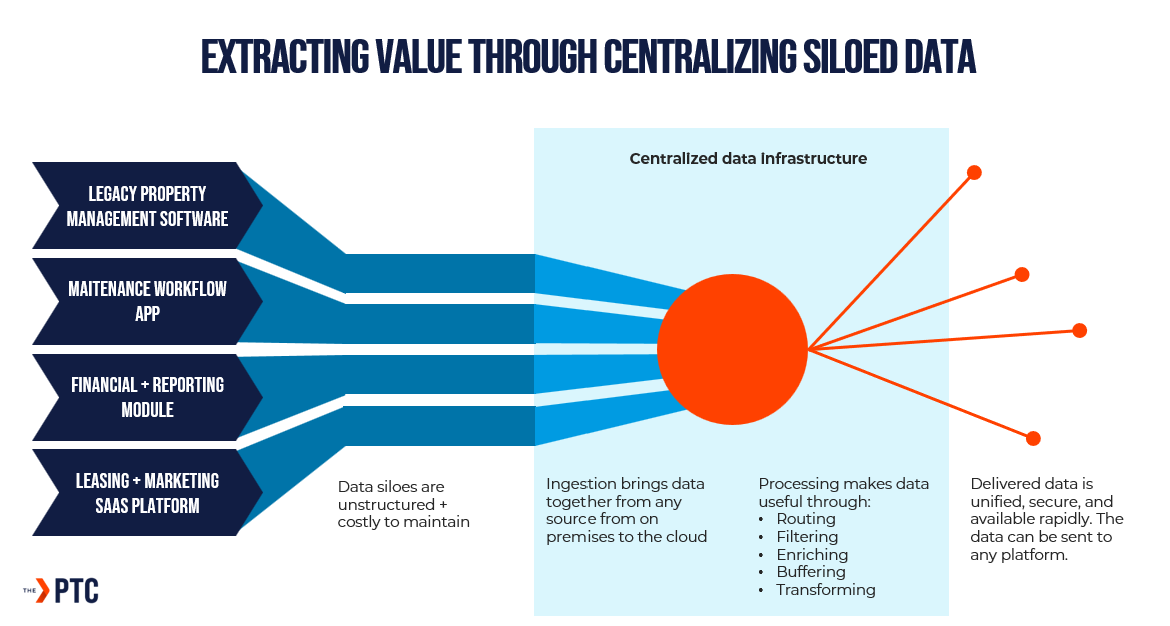
While replacing individual workflows with automation may produce efficiencies, the true alpha is in centralizing the data infrastructure between disconnected systems. Automation coordination only becomes intelligent when the data powering decisions is shared.
An automated email sent to a tenant about a late payment is efficient. An automated email that checks the maintenance log, sees a week-long delay in a sink repair, and then offers a personalised apology is intelligent. The latter case demonstrates that greater value can be obtained through centralized systems, rather than just providing the same value as the manual alternative. Aggregated data value doesn’t just apply to tenants or properties, but also wider portfolios, where the richer the datasets are, the more superior the analysis power is. McKinsey research has found that AI-driven operations in asset-heavy industries reduces coordination costs by 20-40%, but only when deployed systematically rather than as point solutions. The core infrastructure is already there, many property management software already offers open integration with other systems or have built their own AI features.
Approach 01: Pre-defined logic-based workflows
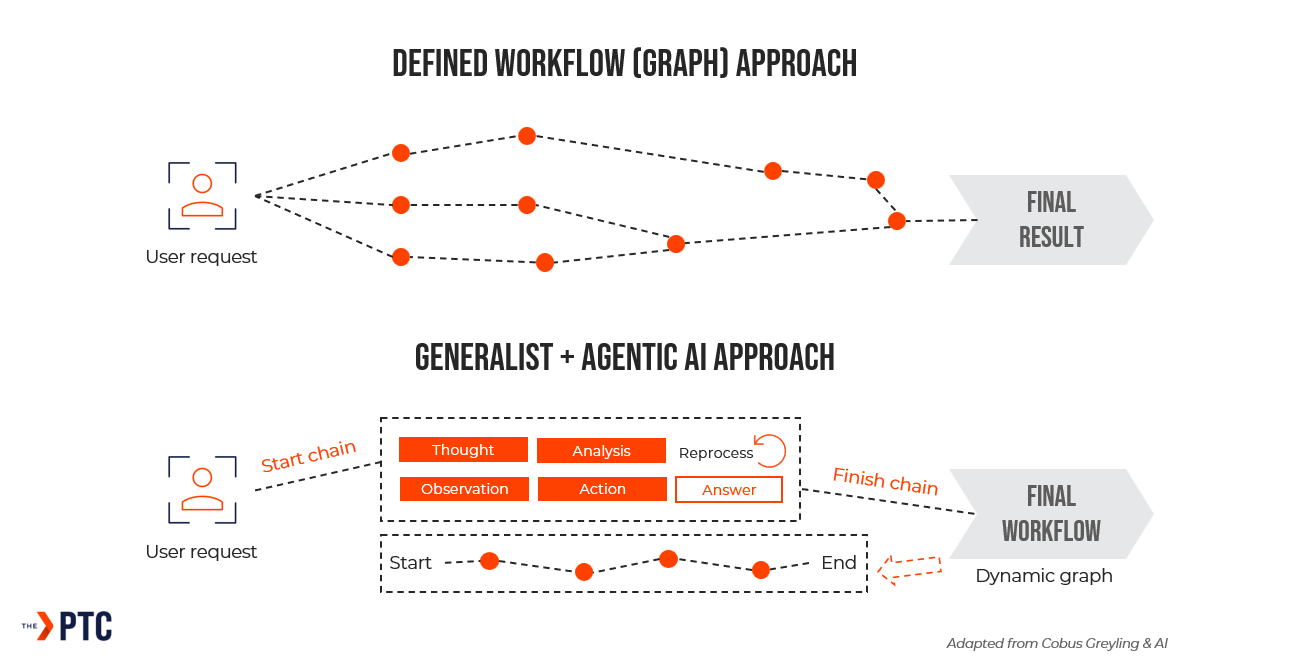
The industry standard approach is in “if-this-then-that” systems, which execute rule-based workflows based on predefined logic. These systems are common in property management and CRMs already, in fact 75% of firms using some form of automation see ROI within 12 months. For example, this could be in automating email send-out after a certain time, where these systems don’t require any machine learning or AI at the most basic level. However, with the introduction of AI, the approach has been drastically enhanced by deploying AI functions at certain stages, where each AI task or role is clearly defined, and cases have to filter through pre-defined stages. For example, after a certain time, the email is to be sent, the timing trigger is systematic, but the email written is created bespoke by a large language model. While AI has advanced, implementing it in rule-based and role-defined workflows produces greater reliability, autonomy, and lower risk of unexpected results.
Approach 02: Generalist + agentic AI task management
In contrast, generalist agentic AI discards rigid pathways, allowing models to autonomously plan, break down, and execute complex goals. Instead of following predetermined triggers, an agent interprets a broad objective, such as "resolve this tenant dispute", and independently determines the necessary steps and tools to reach the outcome. This approach offers massive potential through its adaptability, drastically reducing the need to manually map out complex edge cases. However, there are current pitfalls. Because these systems dictate their own logic for each task, they are often unpredictable. As a result, Agentic AI is difficult to audit and prone to hallucinations, making it riskier to deploy without human oversight.
Ultimately, successful back-office automation in property management relies on matching the right tool to the task. Pre-defined automation is the proven engine for high-volume, low-variance tasks where consistency is key.
In contrast, agentic AI is better suited for complex judgment-heavy workflows, though in its infancy, it carries the risk of hallucinations and unpredictability. To safely integrate both, firms should adopt a phased roadmap: begin by rolling out rule-based workflows to capture immediate ROI, layer in AI chatbots to assist with standard communications, and finally pilot agentic workflows in low-risk areas to explore future-proofed capabilities.
.jpeg)




.webp)




.jpeg)
.jpg)


.jpg)
.jpg)
.webp)
.jpg)
.jpeg)


.png)
.png)

.jpg)

.jpeg)
.jpeg)

.jpeg)
.jpg)
.jpg)
.png)

.jpg)
.jpeg)
.jpeg)
.jpeg)
.jpeg)

.jpeg)


.jpeg)

.jpg)
.jpeg)
.jpg)

.png)
.jpeg)


.jpg)


.jpeg)
.png)


.jpg)
.png)

.png)
.png)
.jpg)
.jpg)
.jpg)
.png)
.webp)
.png)
.jpg)
.jpg)
.jpg)


.png)

.jpg)


.jpeg)
.jpeg)

.png)
.png)
.png)
.jpeg)

.jpeg)
.png)