

Gen AI and The AEC Industry
November 2026

Report Summary
At The Proptech Connection, we sit at the intersection of real estate, investment and technology. This vantage point provides us a unique lens into the rate of technological innovation - in terms of both tech adoption and new technology offerings - whilst also enabling us to monitor how capital pools are driving Construction's ability to digitally transform.
Recent market activity suggests that material changes may be on the horizon for the Construction sector particularly, with the appetite for delivering change very strong. The catalyst for this is the opportunity that AI brings: potentially providing an ability to finally rectify some of the long-term, structural and systematic challenges persistent across the construction lifecycle.
At The PTC, we have worked extensively with our clients on understanding how best to leverage and navigate these shifting dynamics. For many of our clients, a key part of their growth strategy has been to accelerate acquiring digital capabilities, with strategic acquisitions, a model many are favouring. This trend is being played out globally with transaction activity from the market leaders (and also adjunct sector specialists) who anticipate the ability to reshape entire business models of the construction ecosystem. There is much nuance to being able to execute such a strategy successfully and it is not without pain points.
Our analysis and experience mirror the sharp observations and considered thesis of our partners Bram Mommers, Alison Jones and Arjen Adriaanse, who published a thought-provoking article at the end of 2025 structured around the AECOM purchase of Consigli. This report combines their excellent insights with The PTC's research, providing an opportunity to explore further tech advancement and market activity in 2026. We also further highlight key emerging tech use cases, where future adoption is expected and what the impact of this may be.
Industry Context and Challenges
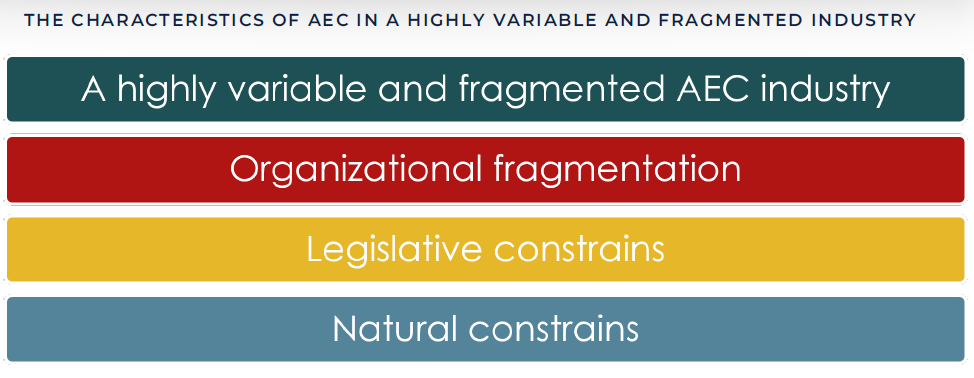
The AEC industry has historically lagged behind many other sectors in achieving productivity gains from digital technologies. This is, in part, because of deep structural variability rooted in environmental conditions, highly localized regulations, and persistent fragmentation both across projects and project phases. These systemic characteristics limit repeatability and, in doing so, constrain the value and scalability of standardized digital solutions.
Digital Transformation and AI Adoption
Previous waves of digital innovation demonstrate that scalable, repeatable use cases are difficult to achieve in the AEC domain. Success has typically come from flexible, project‑specific tools or automation applied within large,relatively homogeneous programs.
Gen AI introduces powerful new capabilities but faces the same structural hurdles, amplified by challenges related to data readiness, interoperability, and the current absence of foundational AI models capable of interpreting vector-based design files. While, for example, modular construction and integrated long-term delivery contracts offer windows of opportunity for greater scale, adoption is accelerating in organic, fragmented ways rather than through large-scale, standardized transformation.
Analysis of the Acquisition
AECOM’s acquisition of Consigli promises access to proprietary AI technology,potential strategic differentiation, and highly specialized AI talent. At the same time, the acquisition introduces risks, including organizational integrationchallenges, talent retention, change management complexity, data quality and regulatory constraints, platform commoditization, and uncertainty around long‑termfinancial returns.
While the market response to the acquisition was muted,investor sentiment reflects caution about whether proprietary in-house AI platforms can deliver sustainable value in a fragmented and rapidly evolving industry. Technology vendors have historically been better positioned to scale repeatable functionality across diverse, project‑based workflows. This suggests that hybrid, best‑of‑breed strategies may ultimately prove more resilient than monolithic solutions.

Key Lessons and Recommendations
·Proprietary in‑house AI platforms may provide short‑term competitive advantage but are vulnerable to rapid commoditization and shifting client expectations.
·Successful AI adoption requires strong change management across the organization and its ecosystem partners,robust data foundations, flexible technology strategies, and active participation in the wider ecosystem.
·Industry‑wide progress depends on value‑driven procurement that creates long-term, scalable demand, alongside shared data standards and inclusive capability-building that supports both large firms and SMEs.
·Organizations should prioritize people,dual innovation strategies (project‑specific and scalable), governance, data stewardship, and adaptability to capture sustainable value from AI.
Conclusion
AECOM’s acquisition of Consigli signals ambition and leadership, but its long‑termsuccess depends on navigating the structural realities of the AEC industry. Addressingthe organizational integration of Consigli, data readiness, and realistic paths to value will be essential.
This paper concludes with executive guidance for global engineering firms, suggesting that effective AI strategies are most likely to focus on building adaptable organizations and delivery models that can selectively leverage AI by combining domain expertise, robust data foundations, and collaborative partnerships.
·Vector files (e.g., CAD/BIM/GIS) encode geometry mathematically and remain editable at any scale, unlike pixel‑based raster images. Current AI models have limited native support for complex vector semantics.
·Capabilities, performance, and ROI figures are vendor‑stated unless otherwise cited; independent benchmarks are limited.
·Value‑based procurement rewards demonstrable productivity and quality outcomes (e.g., data deliverables, automation reuse), not only the lowest upfront price.
·Organizations should prioritize people to maximize the successful implementation of AI, while recognizing that many tasks will be automated or disappear and that success increasingly depends on reskilling, role evolution,and effective human oversight of AI‑enabled workflows
Get the full report
Download your report below